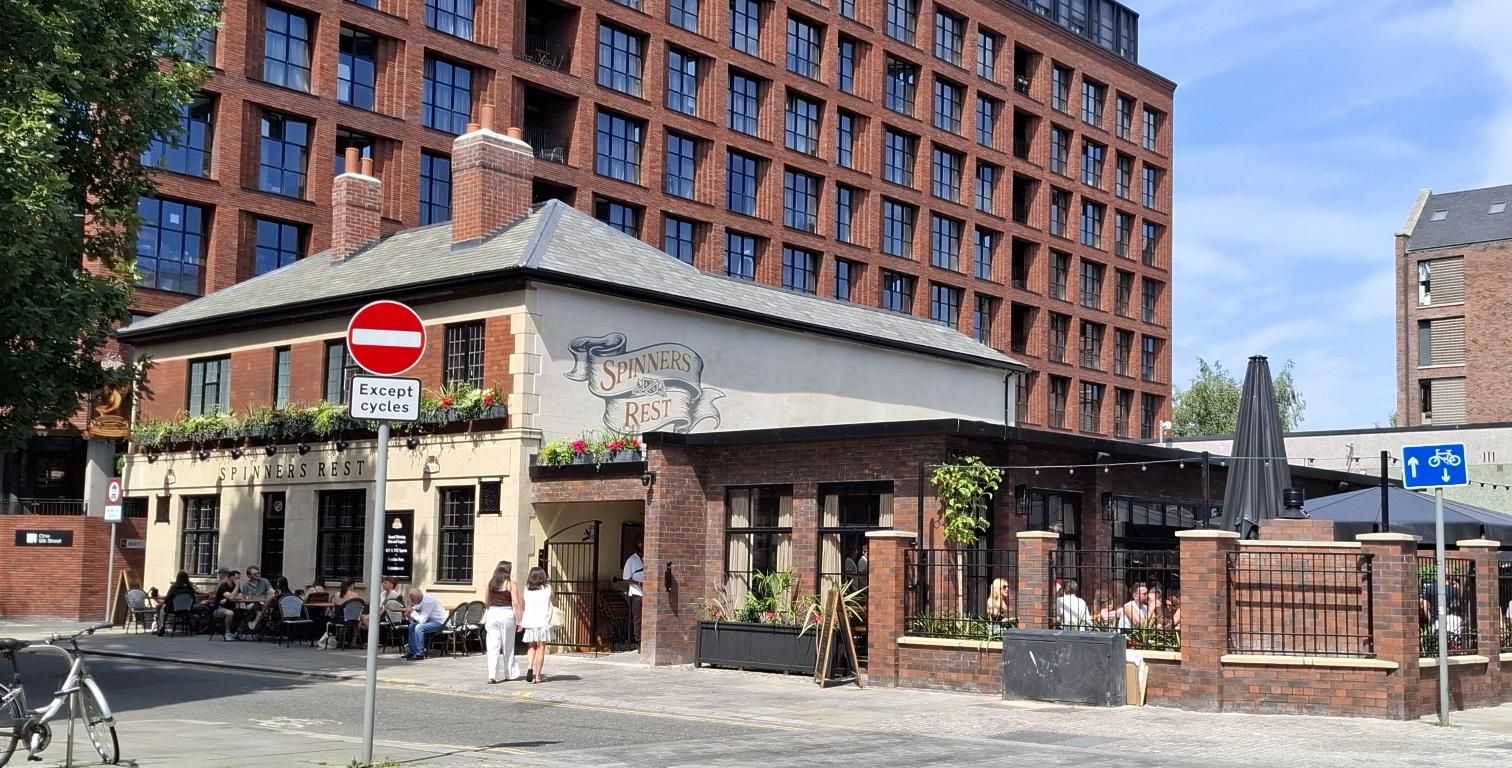
I went to the Spinners Rest in Ancoats for the first time last night as Joseph Holt's Brewery chose it as the pub where their award for the best mild of this year's Mild Magic trail organised by my local CAMRA branch, Stockport and South Manchester, would be presented.
An early nineteenth century inn which later became a keg only Irish pub called the Shamrock, and was once allegedly frequented by members of the Quality Street Gang, Holt's bought it in 2019 and reopened it this summer after an extensive refurbishment, with a new name connected to the streets of former textile mills in the Ancoats area just north of Manchester city centre.
It's pretty much what you'd expect from a Holt's refurbishment, with lots of dark wooden panelling, Victorian style lamps and leaded glass, and they've clearly spent a lot of money on the place, something reflected in the slightly higher than normal prices which you often find in their improved pubs compared to the more basic community locals they're known for throughout Manchester and Salford.
There were four cask beers on the bar, bitter, mild, Two Hoots golden ale and a seasonal IPA. I tried the first two and found both of them to be in good form.
There's also a small beer garden at the side of the pub, where last night lots of young people were sitting outside in, as they were at trestle tables in the now pedestrianised apart from a bike lane Stevenson Square which I walked through en route to Ancoats from Piccadilly station, giving the city centre something of a continental air.
I raised a glass of Samuel Smith's Nut Brown Ale last night to the memory of Humphrey Smith, the owner of the brewery in Tadcaster, North Yorkshire, who has died at the age of 81.
He was a complex and controversial figure, as alluded to in this obituary of him.
I like the brewery's beers, in cask, bottle and keg, and their pubs (the ones that are still open that is). I'm not sure I would have liked the man himself though had I ever met him, and I certainly didn't like the way he treated his pub managers.
Let's hope that those who inherit his empire run it in a less feudal manner, and without some of his idiosyncratic rules, while retaining the traditional feel of the pubs and quality and reasonable prices of the beers.
This weekend s Guardian had a list of the best hundred novels, compiled from top tens submitted by writers and critics (I've read thirty eight of them).
I thought I'd compile my own top ten. It was much harder than I expected, and I could easily have added another ten novels to the list. Those that failed to make this most difficult of cuts will have to be summarised by the name of their authors, in no particular order: Albert Camus, George Eliot, William Faulkner, James Joyce, Charles Dickens, Thomas Hardy, Thomas Mann, George Orwell, Gabriel Garcia Marquez, Fyodor Dostoevsky, Leo Tolstoy, Emile Zola, Graham Greene.
So anyway, here's my top ten.
1. Günter Grass, The Tin Drum
2. Günter Grass, Dog Years
3. Salman Rushdie, Midnight's Children
4. Franz Kafka, The Castle
5. Friedrich Dürrenmatt, The Pledge
6. Joseph Conrad, Heart of Darkness
7. F. Scott Fitzgerald, The Great Gatsby
8. Patrick Hamilton, The Midnight Bell
9. Hermann Hesse, The Prodigy
10. Saul Bellow, Herzog
I'm aware that the list is heavily slanted towards twentieth century European literature, and at the top end especially towards magical realism.
I watched the fourteenth frame of the World Snooker Championship semi final between Northern Irish player Mark Allen and Chinese youngster Wu Yize yesterday teatime.
The black ball ended up hanging over the bottom right corner pocket with eight reds clustered around it. Normally the players would agree to a rerack and start the frame again, but with a thirty point lead on the scoreboard Allen declined to do so, and the referee was apparently unable to force him to, so for almost an hour the players clipped the reds or played off touching balls, sending the cue ball back to the baulk end of the table without potting anything. Eventually Allen knocked in the black with a deliberate foul shot and Wu went on to win the frame which lasted an hour and forty minutes, a record since the World Championship moved to the Crucible Theatre in Sheffield in 1977.
It reminded me of the bit in the Patrick Hamilton novel The Plains of Cement where a young boy drives the barmaid in a London pub who's looking after him to distraction by showing her how to play endless cannons in billiards.
There have unsurprisingly been calls for the rules to be changed so that such a frame can never happen again, but the audience who witnessed it live seemed to enjoy the spectacle, as did I watching it on TV, and it's not the only sport where things can technically go on indefinitely: baseball and tennis don't have a clock, and penalty shootouts in football are unlimited too. If it happened all the time it might become a problem, but every few years just adds to the variety of the game.
Two of the beer bloggers I read regularly, Ron Pattinson and Martin Taylor, have both been to the Rhineland recently and I've been enjoying their reports from some of my favourite Düsseldorf and Cologne pubs.
That led me to this piece which fellow beer bloggers Boak and Bailey wrote about Altbier, the beer served in Düsseldorf brewpubs, back in 2008, the year before I first went there, in which they concluded: "To recreate the Alt effect at home: Get a nice brown bitter that you like, chill it for a couple of hours, and pour it carelessly into a 250ml tumbler so that it eventually settles down to half beer, half head. We tried it — it works. A good alt is very like a cold, super bitter English ale. In our humble opinion, this better recreates the alt experience than buying a tired bottle of boring Diebels from your local specialist beer emporium."
I bought a few bottles of Sam Smith's Nut Brown Ale the other day so tried it with one of them, and it definitely worked: I almost felt like I was drinking a glass of beer in a Düsseldorf brewpub, albeit one at the maltier end of the Altbier spectrum (think Schumacher or Schlüssel rather than Uerige or Füchschen).
Altbier is usually, and rightly, compared to a British style pale ale, being hoppy, copper coloured and top fermented, but in Düsseldorf they often describe it to English speaking visitors as a dark beer (which is it compared to Pils, the standard beer in northern Germany). The maltier and darker examples also line up in taste and colour with a brown ale.
On 7th May 1964, Granada TV filmed a programme of performances by touring US blues musicians including Muddy Waters, Otis Spann, Cousin Joe Pleasant, Sonny Terry and Brownie McGhee at the disused Wilbraham Road railway station in Whalley Range, south Manchester, which they dubbed Chorltonville and mocked up to look like a Southern style railroad halt, complete with a crate of chickens and tethered goat.
The show, The Blues and Gospel Train, is now on YouTube and clips from it regularly pop up in both blues and local history pages that I follow on Facebook, together with the same myths endlessly repeated before being debunked.
The programme was filmed at Chorlton-cum-Hardy station
This is understandable for a few reasons. Granada called the station Chorltonville (an actual area of Chorlton-cum-Hardy, the south Manchester suburb which borders Whalley Range) and Chorlton-cum-Hardy station, now a stop on the South Manchester Line of the Metrolink tram system, is on Wilbraham Road, a mile or so west of Wilbraham Road station, and famously mentioned in a Flanders and Swann song.
The show was part of the American Folk Blues Festival
The American Folk Blues Festival ran throughout the sixties, bringing US blues musicians, including some who appeared on the show at Wilbraham Road station, to European audiences in theatres and concert halls. It was organised by German jazz fans Horst Lippmann and Fritz Rau with Chess Records producer Willie Dixon a key contact in Chicago. The tour the musicians were on in 1964 was called the Blues and Gospel Caravan and was promoted by Newport Jazz Festival founder George Wein.
Members of the Rolling Stones were in the audience
By 1964 the Rolling Stones were an established act and were themselves on tour when the Granada TV show was filmed. The confusion seems to stem from their having travelled up to Manchester from London two years earlier to see the 1962 American Folk Blues Festival gig at the Free Trade Hall (where the musicians from the Wilbraham Road show also performed the following night in 1964).
The audience was racially segregated
Granada TV set up the filming with the artists on one platform and the mostly student and white audience, who had travelled there on a special train from Manchester Central Station, seated on another opposite it. The idea that it was racially segregated is usually voiced by Americans who think they're seeing an actual railroad station in the US South, where Jim Crow laws still segregated blacks and whites in the mid sixties, rather than a disused station mocked up to look like one in the south Manchester suburbs. Muddy Waters is playing on the opposite platform when the audience gets off the train at the start of the show, before crossing the track to rejoin the other artists, and there are photos from the tour of the black musicians happily mingling backstage with their starstruck teenage white fans.
And now for a few facts.
The gospel singer Sister Rosetta Thorpe, arguably the star of the show, changed her opening number from the, very appropriate, This Train to Didn't It Rain when she saw the unseasonably wet Manchester weather (pianist Cousin Joe Pleasant, who helps her down from a horse drawn carriage and leads her along the platform, had just performed in a torrential downpour, which gave the Granada sound technicians a few problems).
Filming had to be stopped on several occasions to let freight trains which still ran along the Fallowfield Loop Line to pass through the station.
Johnny Hamp who produced the show for Granada TV already had contacts in the rail industry from filming Little Eva singing her hit The Locomotion with a train background at the Longsight depot in south Manchester in February 1963.
The tour was managed by the twenty-one year old future record producer Joe Boyd. He describes it as his first and still best job in the music industry.
Happy New Year everyone, hope it's a good one for you all.
Just been doing some number crunching of my 2025 beer scores on the CAMRA website. I went to 54 pubs last year, 26 in Stockport and 28 in Manchester, and submitted 99 beer scores.
Ninety of them were 3s (Good), with only a single 1 (Poor) and six 2s (Average). I gave two beers a 4 (Very Good/Excellent), Vocation Bread and Butter Pale Ale at Ladybarn Social Club and Thornbridge Jaipur IPA at the Angel on Stockport Marketplace, so hats off to them.
Cheers, and hope to see some of you at the bar this year.
Draught Bass at the reopened Crown Inn, Stockport, in August